 “I am pleased to inform that we are running an EXCLUSE Black Friday promotion where I can help you upgrade … Would appreciate if you could let me know a convenient time to speak with you with a call back number.”
This is an excerpt from an email I received that appeared to come from a representative at an existing supplier, offering me a discount to upgrade to a new software package. To save embarrassment, I won’t name the company or individual behind it.
The email was riddled with spelling errors and poor grammar, and there were no contact details provided for the sender. Given the number of spam emails I have to deal with every day, I suspected that it might not be legitimate.
After investigation, it turned out that the email was legitimate – and it’s a great illustration of the difficulty companies are facing as they increasingly automate or outsource their engagements with their customer base. I am an existing subscriber, so there was every opportunity for the sender to demonstrate they knew a lot more about me than just my name and email address.
The problem was further compounded by the supplier automatically renewing my software subscription a few days later without my consent, and without giving me the opportunity to apply for the special discounted price that was offered to me in the dodgy email. (It’s another story, but I did get that discount in the end.)
Then, a few months later I received two calls on the same day purporting to be from one of my financial services providers and from my telco. I’ve had a relationship with each of these suppliers that dates back well over a decade, but each call ended in a stalemate.
Despite calling me, both the bank and the telco wanted to know that they were talking to the right person. To do that, both asked me to verify who I was by giving them my date of birth.
My response to each of these callers was: why should I give you private information about me? How do I know who you are?
Now, we live in a world where phishing scams, identity theft and hacking have become increasingly sophisticated. In fact, social engineering – such as asking people for their personal information – has become one of the most effective ways to crack security (read John McAfee ‘joking’ recently that he will use social engineering to help the FBI hack into a dead terrorist’s Apple iPhone).
I raised my concerns with both the bank and the telco. No response at all from the bank (typical), but I did have an interesting conversation with the telco. They had no record of the call, so it could have been malicious. I was also told that they only ask for personal information in exceptional circumstances. When I pushed, it turns out that’s any time that they need to confirm the identity of the person at the other end of the line.
When I explained to the telco’s customer service rep that the practices they are using is normalising insecure behaviour and making it easier for its customers to be compromised, my feedback fell on deaf ears.
So why are these companies persisting with insecure sales and marketing practices? In this digital age, face-to-face and human interactions are being driven down to reduce the costs of customer service. However, that has left companies with fewer opportunities to differentiate themselves from their competition, and for cross-selling and up-selling … but more on that in Part 2 coming soon ….
In the meantime, I’ve got a simple solution that will solve the problem when my bank or telco calls me in the future. If you want to find out, give me a call. 🙂
Adopting Private Cloud
 At Explore Communications, we recently invested in a NAS (network attached storage) device to back up our data. It has some nice cloud-like properties. There’s a web-based user interface to configure folders, to access files, and to set up users and permissions; and our data can be accessed by users on the network or remotely, even from mobile devices.
Sounds good, but why didn’t we just go for a public cloud storage option? It probably would have been cheaper and less of a technical risk. However, I wasn’t comfortable with pure public cloud. I didn’t want to be using up our precious (and still quite slow) broadband quota to upload and download data, especially large video and graphic files. Also, I’m still not comfortable with entrusting a third party with my sensitive data. And it’s not just my generation that feels that way – Millennials are also very aware of online security risks.
Globally, that view on security is shared by the majority of enterprises. Technology Business Research (TBR) this week reported that 71% of private cloud users view private cloud as superior to public cloud based on security. That view holds true especially for the largest enterprises that tend to have the most stringent governance, risk and compliance policies in place. As a result, TBR estimates the private cloud market will grow to US$44 billion by 2020.
OK, so our NAS device is not true private cloud – it’s still a physical device that we have to look after ourselves and the storage capacity is fixed rather than flexible – but it does deliver the cloud properties that our small business needs right now.
TBR also cites this growth in private cloud as part of a corporate transition to hybrid IT environments (a mix of on-premise with public and private cloud). Explore Communications is currently not big enough or complex enough to take advantage of hybrid cloud, so for now it’s better to be safe than sorry.
The collective unconscious of online corporations
 In the last few pages of ABC Radio presenter Richard Glover’s book about building his own mud brick house in the NSW Southern Highlands – The Mud House – Glover quotes the psychologist Carl Jung who felt he had been “reborn in stone” as a result of the experience of building his own house. Glover concluded that building his own place had defined him too. “I made that house and the house made me.”
Earlier on the same day that I was reading Richard Glover’s book, I saw that Amazon was opening its first bricks-and-mortar retail store (‘Amazon opens first physical bookstore in Seattle’, 2 November 2015, Engadget) and I was struck by the thought:
Maybe companies like Amazon that have defined the digital economy with revolutionary online business models are struggling to truly define their own identity? Maybe a logo, a website, a slick business model, and a bunch of data centres and warehouses are no longer enough for these corporations born in the Internet era.
The famous Swiss psychologist Carl Jung, who coined the term the ‘collective unconscious’ first built his own house, Bollingen Tower, on Lake Zurich in 1923.
Based on Jung’s ideas, there’s an interesting perspective on how architecture defines us in an International Association for Analytical Psychology paper from 2004, which I think is just as relevant to corporate identity – especially large enterprises that have grown from an ‘online-only’ base:
“Houses express our individual character. Whether visiting Bollingen or Graceland, Mt. Vernon or Anne Frank’s house, unique places such as these draw us to them through their promise to tell us not only about their owners, but about ourselves. Architecture is a subjective language that expresses the people and culture from which it derives, just as Jung’s tower reveals a great deal about both the man and his time. “From the beginning,” he wrote “I felt the tower to be a place of maturation – a maternal womb – in which I could become what I was, what I am, and will be. It gave me a feeling as if I were being reborn in stone. I built it in a kind of dream. Only afterwards did I see how all the parts fitted together and that a meaningful form had resulted: a symbol of psychic wholeness.” (Jung, 1963, p 213-214).” (‘Mystical Emergence: An Architectural Journey Through Jung’s Tower’, IAAP)
Amazon is not alone in expressing a need to express its identity through physical architecture, even if it flies in the face of business sense. Gizmodo, for example, doesn’t see the new Amazon Books store making money:
“Amazon’s got a lot of stick for causing the demise of physical bookstores, so it’s a little strange to see it opening up a store — even with the big-data approach to inventory, it’s difficult to imagine Amazon Books turning a profit.” (‘Amazon’s First Real Store Opened Today’, 4 November 2015, Gizmodo Australia)
Then there’s that widely-shared paragraph from TechCrunch about the latest ‘sharing economy’ darlings which, funnily enough, hasn’t stopped them from investing in their own fantastical architectural expressions.
“Uber, the world’s largest taxi company, owns no vehicles. Facebook, the world’s most popular media owner, creates no content. Alibaba, the most valuable retailer, has no inventory. And Airbnb, the world’s largest accommodation provider, owns no real estate.” (‘The Battle Is For The Customer Interface’, 3 March 2015, TechCrunch)
Airbnb went to town converting an old warehouse in San Francisco into its global headquarters, complete with eight replica iconic Airbnb listings:
“Any of the company’s 200 employees can schedule a team meeting in Bali, or camp out for a few hours with a laptop in Milan. They also restored the building’s former president’s office from 1917, when the warehouse was a battery factory. And, perhaps most audaciously, the Airbnb team converted a pre-existing cylindrical room into a model of the War Room in Stanley Kubrick’s 1964 Dr. Strangelove.” (‘Inside Airbnb’s Whimsical New Headquarters’, 9 December 2013, Fast Company)
And Uber is building its “first wildly ambitious, kind of ridiculous, and generally stunning headquarters to accommodate a ballooning headcount as growth explodes.” (‘Uber reveals plans for a giant glass headquarters in San Francisco’, 29 May 2015, The Verge)
However, it looks like Google has decided not to open its first ever retail store, despite reportedly spending “$6 million renovating the space” (. You can see the psychology behind the original retail plans – wanting something bigger and better than two of its competitors Microsoft and Apple – who have been opening lavish retail outlets all around the world.
It’s good to see there is still some common sense prevailing.
(Pictured above: “CG Jung’s tower in Bollingen, Swiss”, available under the Creative Commons Attribution-Share Alike 4.0 International, 3.0 Unported, 2.5 Generic, 2.0 Generic and 1.0 Generic licence.)
Google becomes Alphabet … well, not really
 Overnight, Google announced that it is changing its name from Google to Alphabet – but only as the name of its listed entity on NASDAQ. On the face of it, that seems a crazy move given Forbes’ estimate of Google’s brand value at US$65.6bn.
As it turns out, there’s really not much to the story. Google is hardly going to jeopardise its brand equity. In fact, the new Alphabet brand is deliberately as far removed from a logo as you can get. It’s a plain, sans serif font (Arial?), the name is as common and generic as it can be, and the only concession to design is that it’s in red, not black.
Instead, Alphabet is Google’s way to create some structure and “transparency” for its underlying businesses, creating Alphabet as a holding company. Cynics will be looking to other angles for the decision, such as potential tax minimisation opportunities and avoidance of future potential anti-trust actions. Maybe it gives Google the opportunity to distance itself from its “don’t be evil” motto – Alphabet is a new corporate identity, after all. (See further, ‘Google is now Alphabet: making sense of a crazy corporate announcement‘, SMH, 11 August 2015).
What it does do is allow Google (Alphabet) to separate out its profitable core search and advertising business from its other more speculative investments and incubator projects, such as Google X research labs.
However, corporate identity has a way of developing its own brand and persona regardless of best attempts to suppress it. The prime example of that working is Warren Buffett’s Berkshire Hathaway – its corporate website is the epitome of anti-brand.
Funnily enough, the media has already made the connection between Alphabet and Berkshire Hathaway:
In recent years, Page has been pushing the company to operate like Berkshire Hathaway, as a constellation of companies tied together through investments.
(‘Google Renames Self Alphabet, Gives Sundar Pichai Better Title‘, re/code, 10 August 2015)
It will be interesting to see what happens to Alphabet’s brand over time. I’m guessing it will develop a life of its own.
(Pictured above: “Plastic alphabet 02”, Martin Abegglen, available under a Creative Commons Attribution-Share Alike 2.0 Generic licence.)
Losing Touch with Reality
 At the end of May, we heard the ‘great’ news that Australia’s Great Barrier Reef had escaped an entry on UNESCO’s List of World Heritage in Danger.
However, any connection with reality and the dire environmental implications of a UNESCO ‘in danger’ listing were lost in the marketing and PR efforts that followed.
In a joint statement from the Federal and Queensland State Governments, it was announced that UNESCO had ‘recommended against the Great Barrier Reef being listed as “in danger”’ and that ‘Australia and Queensland’s efforts have been praised.’
While not called out in the joint press release, the key marketing and PR message was pretty clear – both in the lead up to the decision and immediately afterwards – an “in danger” listing would have been a threat to the region’s tourism industry.
“An in danger listing could have been disaster for the tourism industry”, says the reporter dutifully in the Sky News broadcast piece after the UNESCO decision was announced.
The accompanying story from AAP expands on the point: “There were fears tourists would stop visiting the reef, which contributes about $6 billion to the national economy each year.”
(‘Ministers say Great Barrier Reef on the mend’, Sky News, 31 May 2015)
The ABC was a touch more circumspect, but still swallowed the same line:
“It is a significant reprieve for the Queensland and Federal governments, with an adverse listing being potentially disastrous for the tourism industry.”
(‘Great Barrier Reef: UNESCO recommends world heritage site not be placed on ‘in danger’ list’, ABC News, 1 June 2015)
A week or so after the announcement, it turns out that reporting of water quality improvement – one of the things that “saved” the Reef from being listed – was “not necessarily true”. (‘Great Barrier Reef: Public reporting of water quality ‘misleading at worst’, Queensland auditor-general says’, ABC News, 11 June 2015)
“In Danger”
So what exactly is the List of World Heritage in Danger? There are currently 46 properties around the world, and the criteria for “in danger” is laid out under Article 11(4) of the Convention Concerning the Protection of the World Cultural and Natural Heritage (my italicisation below):
“…threatened by serious and specific dangers, such as the threat of disappearance caused by accelerated deterioration, large-scale public or private projects or rapid urban or tourist development projects; destruction caused by changes in the use or ownership of the land; major alterations due to unknown causes; abandonment for any reason whatsoever; the outbreak or the threat of an armed conflict; calamities and cataclysms; serious fires, earthquakes, landslides; volcanic eruptions; changes in water level, floods and tidal waves.”
We are talking about some really serious consequences, and in their defence both Sky News and the ABC did cover UNESCO’s ongoing concerns:
“Outlook for the Reef remains poor, with climate change, poor water quality and impacts from coastal developments a major threat to its health.” (Sky News video)
The grim irony is that by linking an “in danger” listing with a threat to the tourism industry, we are missing the point entirely.
UNESCO’s “in danger” listing is a threat to the tourism industry and not because it “could cause reputational and ‘brand’ damage to the reef” (yes, that’s exactly how SpiceNews reported it).
No – we could lose the Great Barrier Reef altogether, and where would that leave the tourism industry?
(Pictured above: “Coral Outcrop Flynn Reef”, Toby Hudson, available under a Creative Commons Attribution-Share Alike 3.0 Unported licence.)
Apple, Docker and Cloud (no Segway)
 In a recent internal communications project I had the opportunity to gain an interesting perspective on emerging IT and technology trends.
To promote an upcoming technical training seminar, I emailed out a questionnaire to help compile profiles on each of the 30 participants – who were solution architects from around the world specialising in cloud computing and data centres.
The questions included these three:
- In your view, what is the most exciting current development in IT?
- What is your favourite tech gadget?
- What is the next big thing in cloud computing?
Given the depth of knowledge and experience that each of these technologists had, it was not surprising that there were some wildly divergent responses. What did surprise me was that a number of them said that they were not really into gadgets (and no-one said the Segway was their favourite gadget).
With IT technical specialists, I think we too quickly assume that they are all techno-geeks.
Most Exciting Current Development in IT
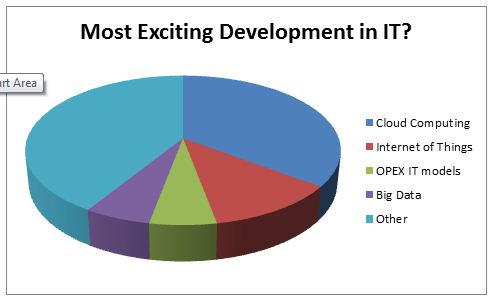
Not surprisingly, given the specialisation of the solution architects surveyed, a strong frontrunner was cloud computing accounting for 35 percent of responses, but there was also some popularity for IoT – the Internet of Things.
And what was in the ‘Other’ category? Responses included machine-to-machine (M2M), virtual reality (VR), automotive safety, automation, agile software development, wearable technology, , 3D printing, service-oriented IT, DevOps, virtualisation and consumerisation of IT.
Next Big Thing in Cloud
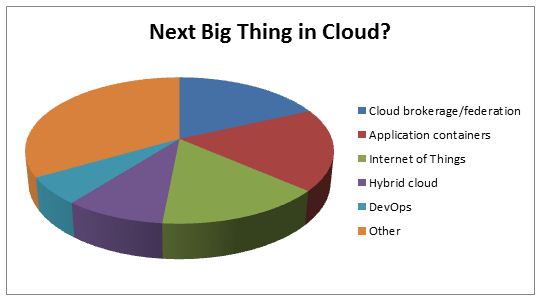
The question on the next big thing in cloud again threw up a range of divergent responses, but there were some clear trends, with support for cloud federation/brokerage and application containers both at 18 percent, followed by IoT at 15 percent. The ‘Other’ category included single nominations for computing power, community clouds, a killer SaaS app, big data, security, orchestration, and automation.
Favourite Gadget
Finally, we had a fun question – what’s your favourite gadget? Again, there were a lot of different nominations but also one that stood out: Apple. Combining the responses received for Apple, iPad and iPhone, they represented over 35 percent of the total. The only others to rate more than a single mention were Microsoft Surface and the Tesla Model S (two nominations each). We also had a lot of ‘non-tech’ gadgets nominated, including a chainsaw, a slide-rule, and super-light waterproof fabric. The ‘Other’ category also included Bluetooth headphones, drones, safe driving tech, Android phone, Xbox 360, Raspberry Pi, Oculus Rift, Arduino board, Bose noise-cancelling headphones, and the BMW i8.
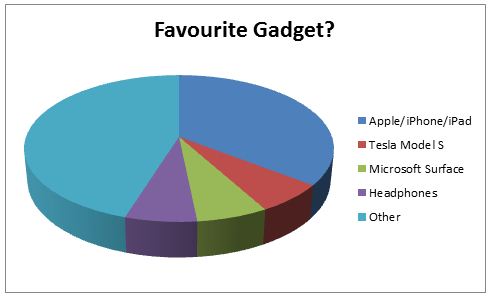
What’s really interesting in the gadget responses is the shift in thinking about Apple. Five to ten years ago, I wonder if there would have been the same popularity among high-end technologists for Apple’s devices and ecosystem? Amongst IT architects, it was a Windows and Linux-dominated mindset back then.
Looking for underlying themes across all three questions, you would have to say that there is a real appeal among technologists for the trend towards simplification and abstraction brought on by the world of Apple and cloud computing. The complexity can be hidden behind the user interface – if you want to install an app or spin up a server, it just works. There is also a strong interest in the impact that the hyper-connected future (IoT, wearables, automotive developments, etc.) are starting to have on the IT industry, particularly cloud computing.
For cloud itself, I was surprised with the number of people who specifically called out Docker as the next big thing in the field of application containers. The facilitation of easier application development on the cloud will be something to watch …
(Pictured above: “Segway polo”, Braden Kowitz, available under a Creative Commons Attribution-ShareAlike 2.0 Generic (CC BY-SA 2.0) licence.)
#Mobilegeddon Scaremongering
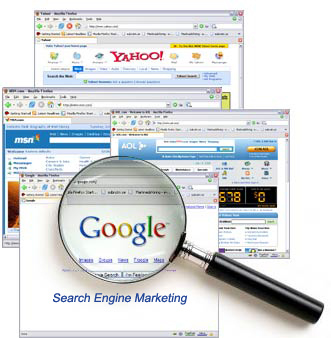 Is Google’s ‘Mobilegeddon’ the latest bit of scaremongering from the SEM quacks? If the headlines in both Australia and the US are anything to go by, the tactic is working.
Mobilegeddon is this thing where Google, on 21 April this year, changed its organic search algorithm to favour websites that had been optimised for smartphones.
The WSJ, in ‘Google’s `Mobilegeddon’ Could Affect Major Companies‘ cites research from ‘digital marketing agency Merkle | RKG, [that] 46% of Fortune 500 companies and 25% of top retailers did not have websites with “mobile-friendly” designations from Google at the beginning of April.’
In Australia, one of the local digital agencies had the same idea:
‘We took a list of the ASX 200 companies and we ran all of those companies through the Google mobile readiness tool, and what that indicated was that 51.5 per cent of the ASX 200 company websites were not deemed as mobile ready by Google, and the remaining 48.5 per cent are in good shape for the change.’
– from ‘Google’s Mobilegeddon: Fears more than half of Australia’s big companies will disappear‘, ABC News, 21 April 2015
Does it really matter if an ASX 200 or Fortune 500 company’s website isn’t optimised for mobile? Yes and no.
Yes – because there is no doubt that an increasing proportion of web browsing is happening via mobile devices.
No – for two major reasons, there is no rush for these big companies to create mobile-friendly versions of their sites.
First, these companies already have massive brand equity and recognition – turning up on the first page of a Google search is just a blip on the brand radar for them. Sure – it might have some impact on the brands in their portfolio, particularly consumer ones – but not their main corporate identity.
Second, did anyone really think that these big brands would disappear from Google searches?
Here’s what Google had to say about ‘Mobilegeddon’:
head of mobile at Google Australia, Lisa Bora, says the tag is a misconception.
“Firstly, mobile-friendliness is just one of 200 signals that we use to determine the ranking of results,” Bora says in an April 22 blog post.
– ‘Google promises sites won’t disappear‘, BRW 22 April 2015
For those smaller players and brands, anxious to climb up the rankings in Google organic searches, sure – it’s important to think about your online presence for mobile web browsing – but that’s also about the customer experience, not just your search ranking. And, if you are banking your marketing success on search engine optimisation (SEO), think again. Paraphrasing Google’s Lisa Bora, it’s just one of 200 signals that determine if someone wants to do business with you.
(Pictured above: “Search-Engine-Marketing”, By Danard Vincente, available under a Creative Commons Attribution 2.0 Generic (CC BY 2.0) licence.)
 Humour can be a great way to promote your business, especially if you are brave enough to poke fun at yourself and your industry.
A great example is this week’s very clever marketing campaign – a combined effort from Getty Images’ iStock online stock photo business and Twentieth Century Fox, promoting its new movie ‘Unfinished Business‘. An email was sent out to iStock members this week offering a set of free stock images (we got the email here at Explore):
In case you didn’t get the memo, you’ve got the green light to download your free #UnfinishedBusiness stock images.
Yes, they are a set of those really clichéd corporate images that come up time and time again when you go searching for that perfect photo to illustrate ‘teamwork’, ‘productivity’, or some other business concept or value you are trying to portray. The only difference is that these photos feature Vince Vaughan and the rest of the cast of a big Hollywood comedy.
While it’s clever, it works more in favour of Fox than iStock. ‘Unfinished Business’ looks like it’s poking fun at the world of business clichés and business-speak – so corporate stock photos are a perfect butt for the movie’s jokes. Still, it’s a great piece of exposure for iStock, and will probably attract a whole new bunch of members.
However, the most effective ‘making fun of yourself’ marketing effort recently has to be ‘This is a Generic Brand Video‘ from dissolve.com last year, inspired by a parody piece from Kendra East in McSweeney’s Internet Tendency. In marketing, we’ve all seen these videos (and probably been responsible for making a few) – but the video is a perfect showreel for the dissolve.com’s business – selling stock video clips. In fact, links to license the clips featured in the video are conveniently included at the bottom of the page!
Photo at top used in accordance with iStock’s Editorial Use Only licence.
Extreme Sports, Social Media and Smart Phones
 This week has seen a set of mind-boggling numbers announced from Apple, Facebook and … Red Bull.
Let’s talk about Red Bull first. The energy drink slash extreme sports promoter has just clocked up one billion views on its YouTube Channel, since posting its first video back in 2008. The most popular videos include clips from the amazing Scottish cyclist Danny MacAskill and the Austrian skydiver Felix Baumgartner – both of whom are sponsored and heavily promoted by Red Bull.
Speaking of billions of views, as part of Facebook’s latest earnings announcement, the company has stated that three billion videos are viewed on its site every day. According to independent US tech news site Re/code, that figure compares to just (just!) one billion views per day back in September last year. The scary thing is that this number only accounts for the videos that are natively uploaded into Facebook, and not videos referenced from other sources, including Facebook and Vimeo.
OK, we can get into a debate over how many videos are really watched compared to, say, Facebook, given that Facebook has an auto-play feature running on its clips – but it is still a big number nonetheless.
Facebook’s ad revenue for the last quarter of 2014 was US$3.59 billion – the vast majority of its overall earnings for the period – with engadget reporting that ads from mobile accounted for a whopping 69 percent of that revenue. According to TechCrunch, 65 percent of Facebook’s video views are via mobile devices.
Finally, on to Apple’s ‘insane’ quarterly earnings which included posting US$18 billion profit – the largest quarterly profit figure by any company in history. That result is on the back of selling 74.5 million iPhones for the quarter, which has been calculated at a rate of 568 iPhones sold every minute. Considering the intense competition from the likes of Samsung, these are results are incredible – and show just how much growth there still is worldwide in the smart phone space.
So, what do all these numbers mean for the owners and publishers of content, and their sponsors and advertisers? If you have highly-compelling, spectacular extreme sports video that is easily shared via social media and viewed on a mobile device, you are on to a winner. If not, try and create some!
(Pictured above: ‘Red Bull can’, by noelsch, available under a Creative Commons Public Domain Dedication (CCO 1.0 Universal) deed.)
Christmas e-Marketing – Bah, Humbug!
 Something odd happened today. I received a Christmas message from a marketing agency and it caught my attention. There was nothing particularly striking about the email; the design was not overly creative– a cut out Christmas tree and simple little blinking star animation – and the message was a generic ‘wishing you and your family …’.
What stood out was the sender. I looked at the name, which was quite distinctive, and thought, ‘I’m sure I’ve been receiving emails from this guy for years, and never really paid any attention’. My email management is poor to say the least and, when I searched back in my email archive, I found a handful of emails that I hadn’t deleted from this marketing agency going back to 2007 – seven years!
I know nothing about the agency, I have no idea how I ended up on its mailing list, and for some reason I have never asked to be removed. Maybe the frequency of emails was so unobtrusive that it was easier to ignore them or, subconsciously, maybe there was some reason for me to do nothing and let the emails keep coming.
Would you class this as a successful marketing approach? There are two schools of thought on this one.
On the one hand, you could consider it a monumental waste of effort. At least seven years’ worth of e-marketing for not a single response – no emails opened or read and no click throughs from me. Sure, it’s a volume approach so the individual cost and effort is minimal. Let’s say my email address was acquired in the first place – a few cents at the most – then the ongoing cost per email sent, which again, probably amounts to just a few cents. Add it all up and, over the years, this marketing agency has probably spent just a few dollars in marketing to me. At some point though, wouldn’t you take a look at your database, and decide that after seven years of zero response, maybe it’s time to quietly delete my email address and move on?
On the other hand, you could argue that with perseverance, the marketing agency has finally achieved some cut-through, albeit in a perverse way. I’m finally taking notice! For a minimal marketing cost and effort, time and weight of numbers has worked. Who knows, after the next email I receive, maybe I’ll pick up the phone and talk to them.
The truth is, I would never use this agency, let alone talk to them. Why not? It’s lazy marketing. There is no attempt to understand what I need or if I am even the right target audience. It’s just a numbers game for the agency – there is no analysis of the success of its approach in marketing to me.
And a Christmas message? I don’t know who you are, because you have never bothered to engage with me in any meaningful way. Sure, send me through ‘useful’ advice on ‘Expanding the Reach of your Email Marketing with Social Networking’ or ‘Targeting Potential Customers for Better Marketing Results’ (I went back and read the agency’s old email subject lines) – but don’t make out we have a personal connection if you’ve never bothered to create one.
I think I am finally going to hit the ‘unsubscribe’ button.
On a brighter note, I’d like to wish all Explore Communications’ past, present and future clients and their families a very merry Christmas and happy New Year!
(Pictured above: “Patrick Stewart as Scrooge”, By Tnarik Innael, available under a Creative Commons Attribution-ShareAlike 2.0 Generic (CC BY-SA 2.0) licence.)
 explorecomms.com.au