Don’t Try and ‘Own’ Social Media
 I wrote a quick post about the #QantasLuxury social media disaster as it was happening the other day, and I’ve since read a number of perspectives on it – ranging from the opinion that it was exactly what Qantas wanted to happen to the dominant view that it was an epic social media fail. What I love about most of the commentary is that it is written from the perspective that you can exert some form of control over social media, and manipulate it to your own ends.
That’s a fundamentally flawed position, but one that comes from the prevailing desire that most marketers have to control the channels they use to promote their companies’ branding and messaging. In the Havard Business Review blog post I linked to above, Alexandra Samuel writes about ‘a social media team’s desire to “own” this new channel’ – and that’s a big mistake.
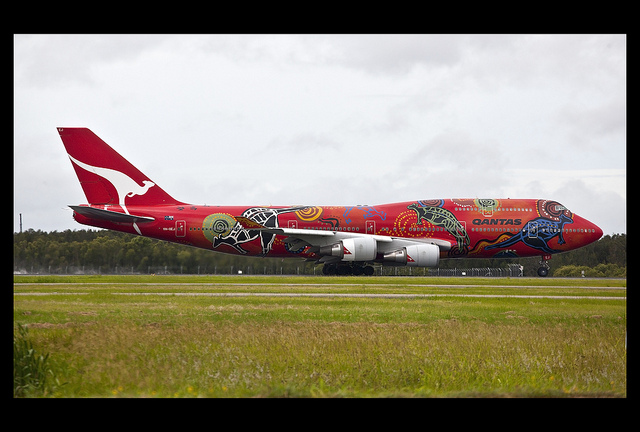
The only channels you can truly ‘own’ are the ones over which you have complete control. These includes advertising, direct mail, your people, and your own physical (like the fantastic painted Qantas plane pictured above) and digital properties. They do not include traditional media, social media or public opinion. When you try to apply conventional marketing strategies to the channels that you don’t own, that’s when things become unstuck.
The most important marketing activity you can perform as an organisation is to tell your own story as well (and as consistently) as you possibly can to your range of stakeholders. That’s going to involve subtle changes in the message to suit different channels and audiences, and at times to take the decision to avoid or limit your activities on those channels where you have very little ‘ownership’. My initial thoughts about #QantasLuxury were that Qantas should keep its head down and focus on the channels where it can completely control the corporate image – and I still believe that would have been the best course of action.
If you think about it in PR terms, you’re not likely to pitch a story to the journalist who is openly hostile or antagonistic towards your organisation, unless you truly believe that you have a good chance of changing their opinion. It’s the same thing, but on a larger scale in social media. If you have a community against you, think really carefully before you pitch a story to them, because they will take it and run with it in a way that can be damaging to your organisation’s brand and reputation.
And, given that you don’t own social media, you can’t stop them.
(Pictured: “QANTAS 747-400 taking off Brisbane_19”, Sheba_Also, available under Attribution-NonCommercial-ShareAlike 2.0 Generic (CC BY-NC-SA 2.0) licence.)
Knowing When to Keep Your Head Down #QantasLuxury
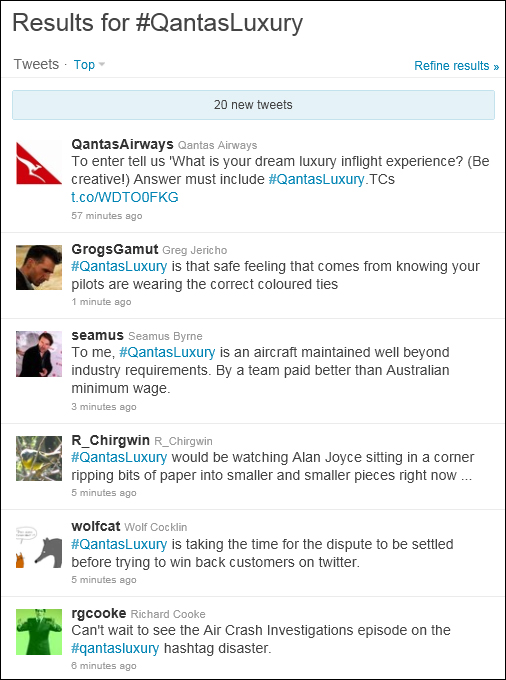 I’m currently watching a branding mistake unfold on Twitter (#qantasluxury). The idea is a good one, but the timing is a disaster.
So what’s happening?
Qantas has launched “A touch of Qantas Luxury Twitter Competition“, where, for a chance to win one of fifty $30 prize packs, you have to:
(a) log onto www.twitter.com;
(b) tweet a response in 140 characters or less to the @QantasAirways tweet ‘What is your dream luxury inflight experience? (Be creative!)?’
(c) tweets must include the hashtag #QantasLuxury.
The prize? “one pair of Qantas First Class pyjamas and one First Class amenity kit” (seriously?)
Unfortunately, this is all happening at a time when the Qantas brand and reputation is really at rock-bottom in the Australian community. The last thing you should be doing is putting your brand in the hands of that community through a social media campaign like #qantasluxury.
If I was Qantas, I’d be sticking to channels where I can completely control the corporate image and message, and keeping my head down when it comes to social media and, to a lesser extent, traditional media.
The other problem is, with the runaway branding train that is happening at the moment on Twitter, how do you stop it?
The PR Who Cried Wolf – Panasonic’s #LostFT10

Credit: Panasonic
It was great to see that the Panasonic Lumix FT10 camera caught on the end of a fishing line was a true story, and not one invented by a public relations firm or communications agency (Lost Panasonic camera mystery solved).
For those who weren’t following the story, “Adam Biro, a glazier from Fairfield East in NSW, snagged the Panasonic Tough Lumix FT10 Camera at Cottage Rock in Cowan Creek while fishing near an inlet on the Hawkesbury River (NSW) on October 15 – seven days after the last image had been captured on the camera.” (http://blogs.panasonic.com.au/consumer/2011/11/02/does-this-lumix-ft10-belong-to-you/) You can see the Twitter #LostFT10 stream here.
It’s one of those stories that is a great PR opportunity for the company concerned. However there was a very high degree of scepticism in the media and the general public that it really happened.
It was almost too good to be true – a new model waterproof camera fished up from the bottom of a river, still working; a series of nice photos from the camera to publish to help ‘identify’ the owner; and a ready-made story perfect for spreading virally via social media.
Many years ago (pre-Internet!) and in a much smaller way, my stepfather’s business had a similar opportunity for great PR. His business was importing tools and laboratory equipment, including German-made locks. One of his Australian retailers sent him a photo of a high-end padlock that had been mangled almost beyond recognition – but you could still make out the lockmaker’s logo. The story was that this lock was one of a number of other locks securing a warehouse. Burglars attempted to break in with a massive pair of bolt cutters but, despite being badly damaged, the lock held firm! However, they still managed to break in, through another entrance that was using a cheaper brand padlock. It was a great story, and the picture was used as a great selling tool for that particular brand.
These days, that story would probably be taken with a large grain of salt, and wouldn’t have the same sort of impact that it had back then.
It’s a shame that these stories are no longer taken on face value. We’ve got to the Boy Who Cried Wolf stage, where we have been hoodwinked so many times by fake PR stories that we no longer believe the story that turns out to be true.
The lost jacket story was the one that tipped things over the edge. A woman was trying to find a man who had left his jacket behind in a cafe, which just happened to be from a certain fashion label’s new season range. What made it worse was that the people involved in the stunt initially denied it was a fake story.
So, what do you do if you are given a golden PR opportunity for your business like the unbreakable padlock or the camera brought up from the murky depths?
There are six questions you need to consider:
- First of all, how confident are you that the story is true? (Chk Chk Boom Girl, anyone?)
- Second, how hard will you promote it in the media or in the public domain?
- Third, is there a good reason for you to tell the story in the first place – which is more than simply promoting the product or service?
- Fourth, what is the likelihood that the story can be independently verified as being true?
- Fifth, what level of involvement do you have, or does your comunications agency have, in the process?
- And, finally, what is your strategy when you are challenged on the story’s truth?
Watching the Panasonic camera story play out over the past week, I think both Panasonic and Suede (Panasonic’s digital communications agency) have handled things pretty well.
Nothing Like Australia … Well, Nothing …
 In the mail yesterday was a postcard from my parents, who are on holidays on Lord Howe Island – a.k.a. Paradise on Earth. Apart from feeling very envious, it reminded me of the ‘Nothing Like Australia’ campaign from Tourism Australia, which I blogged about in September (see https://explorecomms.com.au/2011/09/19/nothing-like-australia/).
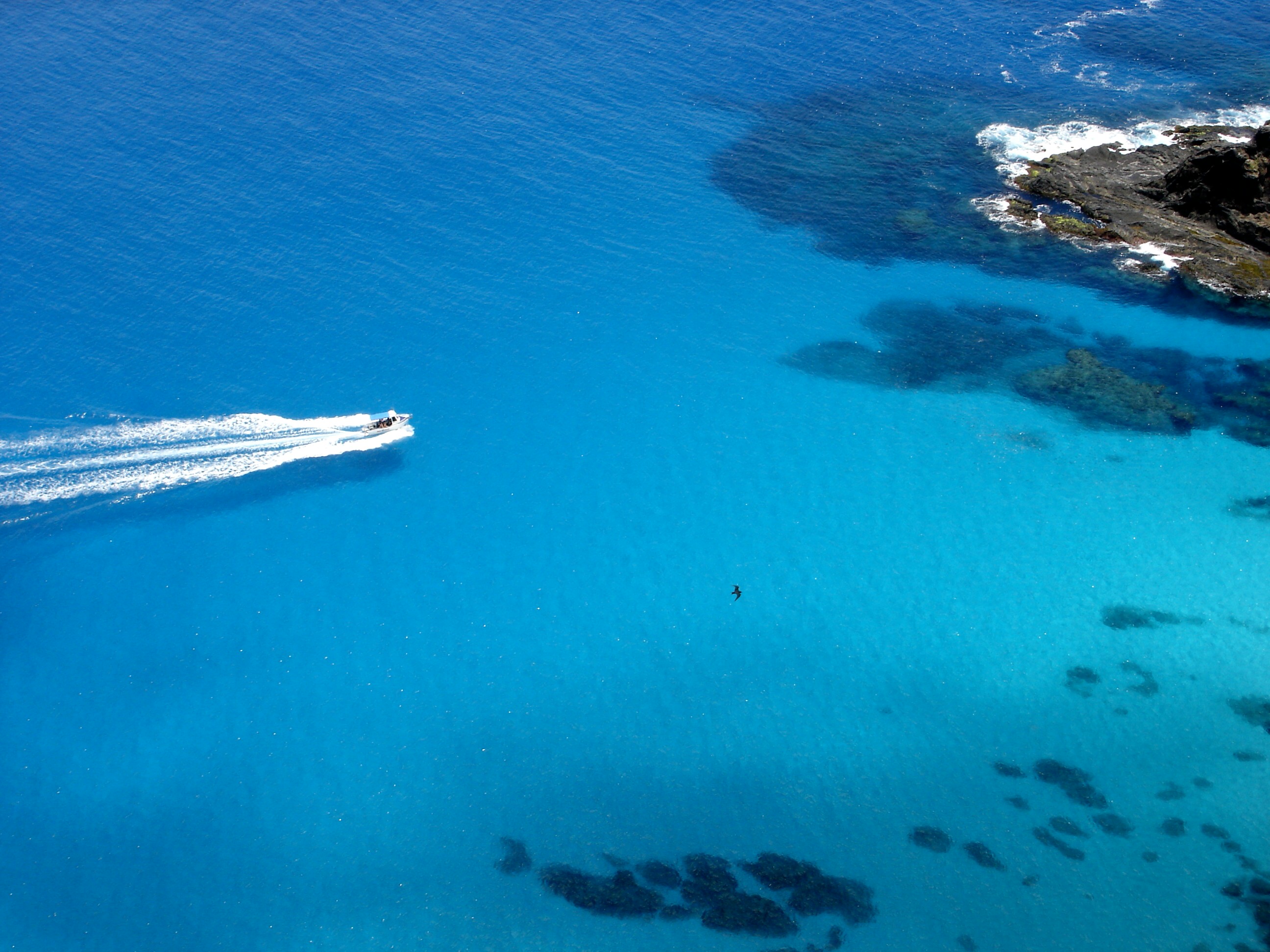
I had forgotten that at the time I was going to post a photo from our last trip to Lord Howe. It’s the image pictured left, which has been an indelible memory for me from the time I stood on the cliff edge where the photo was taken a couple of years ago. What really struck me was how unbelievably clear the water was, and how, not long before the photo was taken, we had looked down on a pod of dolphins working together to herd a large school of fish into the shallows, and watched huge turtles idling slowly over the rocks.
Also, if you click on the photo, you’ll see the full-size image – and the black spot in the middle of the picture should be recognisable as a bird. There were hundreds of frigate birds wheeling around us on the cliff edge, which was also their nesting site. And. from a photographic/artistic perspective, I really like the way that the dive boat so neatly cuts through the blue water with its white wake.
However, when I opened up http://www.nothinglikeaustralia.com.au to submit my photo and brief description, I discovered that not only had the campaign closed, but it was no longer possible to contribute to the site.
I was dumbfounded. Tourism Australia had developed a fantastic web property, but obviously believed that people were only going to contribute to it if they thought they would win a prize. I wanted to contribute my Lord Howe photo out of altruism. As an Australian, I am happy to do what I can to promote Australia as a tourist destination.
So, for what it’s worth, go to Lord Howe Island – it’s unbelievably beautiful. Great for kids too.
Also – Zoofari at Taronga Western Plains Zoo in Dubbo is worth the visit. It’s great to have the opportunity to see the animals up close and after hours. Given I couldn’t publish any of my photos to Nothing Like Australia, here’s an album of photos on Flickr.
I’m just sorry I couldn’t say any of this on Nothing Like Australia.
 I saw an interesting piece this morning in iTWire – SMEs missing out on social network marketing opportunities – based on a report just published by the Australian Communications and Media Authority (ACMA), a statutory authority within the federal government portfolio of Broadband, Communications and the Digital Economy.
The ACMA’s report, which is focused on online shopping and draws on data from its own commissioned research as well as third party sources, juxtaposes the finding that 59 per cent of small and medium enterprises (SMEs) in Australia are taking orders online from customers with the statistic that just 18 per cent of SMEs connected to the internet are using online social networking channels for business purposes.
The report did identify an increase in the percentage of SMEs using social media channels from the previous year’s findings – in April 2010, 10 percent were using social networking for business purposes, but I find the figure surprisingly low given the fact that it can be such a low-cost marketing channel for businesses to use, especially those in the SME space (which the ACMA defines as businesses with 1-200 employees).
The ACMA identifies that there are three major channels for a business to sell goods online – its own website, specialised sites providing aggregation and auction services, and social media – but social media “is yet to develop as a mainstream business tool”.
Of those businesses that are using social media, Facebook is the dominant network, with Twitter a distant second.
When you consider the statistic that during June 2011, approximately 8.6 million Australians visited social networking sites, it’s a huge marketing opportunity that SMEs are missing out on by not being engaged on social media.
The other aspect to this is that you don’t have to be engaged in e-commerce to be using social media. Some of the best examples I have seen of small businesses using social media are very much ‘bricks and mortar’ enterprises, and never likely to engage in e-commerce. Living in the Southern Highlands of NSW, two pretty good proponents of social media that I follow are food businesses – Classical Thai Cravings and flour water salt.
I’m not sure if either business has had professional advice or assistance in setting up and using social media, but they do it really well – engaging with their audience at many different levels. Classical Thai Cravings, a restaurant in Mittagong supports an active Twitter account, a Facebook page and a WordPress blog from its chef and owner, Jason Bailey. (The food is great too, by the way.)
The great thing about being an SME and using social media is that you don’t have to generate a massive following on social media to achieve positive business outcomes. It’s all about hitting your niche audience, keeping your content relevant and engaging, and most importantly making sure that you stay visible and front of mind, so that when someone is making a purchasing decision, they think of you first, and not your competitors. And this is true for any online or offline purchasing decision.
The ACMA’s report can be found at http://engage.acma.gov.au/commsreport/e-commerce.
(Pictured: “Social Media Prism – Germany V2.0”, Ethority, available under Creative Commons Attribution 2.0 Generic (CC BY 2.0) licence.)
Piracy and ‘The Slap’
 I’m dead set against piracy and filesharing. For some reason, people seem to think there is a distinction between theft of physical property and theft of intellectual property. There is no distinction, apart from the fact that it is far easier to steal IP.
However, the thing that really gets me angry is when people try to justify piracy. Here’s the most recent offensive justification from somebody calling themselves Fr3ak talking about the ABC TV show ‘The Slap’:
“Far from detracting from the attractiveness of said content, we actively promoted the creative industries of our countries and we believe that some of these shows would never have had such commercial availability if they had not first been available on Diwana.org or indeed countless other sites around the internet.”
(See http://www.zdnet.com.au/the-slap-leads-to-piracy-site-shut-down-339326077.htm).
These people don’t seem to appreciate or care about the time, effort and creativity that has been expended on the piece of music, film, book, software or whatever it is that they are stealing. If you take something like ‘The Slap‘, its a beautifully written and acted show, and huge numbers of people will have spent countless hours working on it. The ABC is Australia’s public broadcaster, which means all Australians lose out through these acts of piracy, because it has the potential to reduce or even jeopardise overseas sales of the show. Less revenue means less money for the ABC to invest in new programs, which has obvious flow on effects for the local film and television industry and the people working in it.
Fr3ak is the one deserving a slap.
(Pictured: “Pirate Deck at Club Earl”, Earl-What I saw 2.0, available under Creative Commons Attribution-NonCommercial-ShareAlike License 2.0 license.)

Origami Crane - Andreas Bauer (Origami-Kunst)
When I first set up Explore Communications, a friend suggested that I should go onto Freelancer.com to source work. After a month, I don’t think it works for me.
Freelancer.com is a bidding site which brings together freelancers across a range of fields and employers looking to have project work completed.
After getting my friend’s advice, I duly opened an account (explorecomms) and set up my profile and preferences. (I actually wanted to make some changes to my profile, but can see nowhere how it is possible to do so.)
I selected my skills (primarily in the Writing & Content, and Sales & Marketing categories), which determines what projects are sent my way via an automated email.
So far, out of the hundreds of projects received, just three have convinced me to make a bid. I’d class the vast majority of projects posted as ‘definitely dodgy’. Here’s a quick taster of the latest jobs I’ve been alerted to:
| Project Brief (extract) | Project Budget | My Comments |
| I’m looking for someone who can write 100 decent articles from 100 dental keywords and submit them to article directories. | 50 EUR | Definitely dodgy, laughably inadequate budget, not in my area of expertise |
| The project is for writing 10 short (20 words) reviews in 3 days. IMPORTANT: You should have unique IP Address for every review. | $30-$250 USD | Extremely dodgy, also unethical |
| I run a website design company and require 8 press releases written for 8 different keywords. Once we have read and approved press releases we will send full payment and release it instantly. | $30-$250 AUD | Moderately dodgy, ridiculous budget, completely meaningless, why bother? |
| Need some social networking (facebook, linked-in, etc…) Please quote on a package. |
$30-$250 USD | What? |
| We need 5,000 Facebook likes/fans for our Facebook Page. | $30-$250 USD | Dodgy |
| I need 25 400 – 500 word articles about web traffic building. They must pass copy scape. |
$30 USD | Definitely dodgy, surely can only be achieved using some sort of automatic article generator. |
| 8 listings custom for ebay $80 for these listings | $250-$750 USD | I can only assume someone needs a reputable seller to do something dodgy on eBay. |
I could go on but, quite frankly, it’s depressing. While Freelancer.com may have been established with the best intentions, in my field of expertise, all that it is succeeding in doing is filling the Internet with dross, encouraging plagiarism, manipulating social media and allowing unscrupulous operators to source services cheaply and easily to further their dodgy agendas.
Earlier on, I mentioned the three projects that have caught my eye in the month I have been using Freelancer.com. I can’t remember what the first project was all about (my bid was unsuccessful), but the other two sounded pretty interesting.
One was to develop a single brand from three companies coming together as a single entity; and the other was to create a name and tagline for a company that helps small businesses use online marketing. Both sounded great, but both projects are now in “Frozen” status. I’m not quite sure what that means (and could find nothing on the site that explained it), but I’m assuming it means that the employers don’t have sufficient funds with Freelancer.com to pay for the work.
Additionally, the company name and tagline project was updated midway through with this request:
“Please submit your best company names + taglines to me via PM [private message], together with a brief explanation of why you chose them and what message you think they send to potential clients. I will award this job to the top entry/entries based on the criteria listed in the scorechart ….”
I wasn’t going to fall for that trap! Here’s part of my response in my bid:
“I’ve conceived and established brands that have subsequently become global standards, and I have worked with small businesses to establish their identities. Based on your revised brief, I have reduced my initial milestone payment to zero. However, I still think you will achieve the best outcome by working with the right person collaboratively to come up with the company name and tagline.”
Likewise, my bid for the branding project talks to the importance of collaboration. Here’s an excerpt:
“I believe brand and identity development is a collaborative process, and that through this process, I will be able to work with your organisation to create a compelling new corporate identity. My expertise is in working with internal and external stakeholders to develop brand identity and messaging. I have managed two major rebranding programs, and established a number of other brands that have since become the global standard. My quote is to establish a framework for the new identity and go-to-market strategy, a detailed design brief that can then be executed either by one of the graphic design agencies that I work with regularly in Australia, or by a graphic design agency of your choice.”
I can understand how Freelancer.com is a compelling model for coding or application development projects, but for marketing and communications, it’s completely inadequate.
Here’s another blog post that’s worth reading on the subject: The trouble with Freelancer.com.

I loved the cynicism in the idea – a headline that had absolutely nothing to do with the story on ABC’s Technology and Games website. Instead, it was an experiment to see what sort of effect a “click bait” headline would have on readership. The article was actually all about how there is very little new in consumer tech these days.
In the spirit of the experiment, I thought I’d refer to the article in this post, just to see what sort of impact it might have on hits to my site! At the same time, let me take advantage of the situation to link to the marketing and stakeholder communications services that Explore Communications can provide for your organisation: https://explorecomms.com.au/about/ and you can find my contact details here: https://explorecomms.com.au/contact-us/.
While I’m no expert in seach engine optimisation (SEO), ultimately, the success of your business is dependent on the quality of your content, your message and your communications strategy. These are the areas where Explore Communications can deliver.
Telcos are missing a massive marketing opportunity with iPhone 4S, Nokia N9 and Samsung Galaxy S II
 As I was checking up on the status of my iPhone 4 case (on backorder from the supplier until the 16th of November), it suddenly struck me – the telcos are missing a massive marketing opportunity.
In Australia, why don’t we see any Telstra, Vodafone or Optus branded iPhone cases out in the wild? Why do the telcos ship the phones without any form of case for protection, making them more prone to damage until users get around to buying it a case? I’m a prime example!
It’s a huge marketing and branding opportunity for the telcos that’s going begging – for example, a custom red iPhone case with a big logo would be a great way for Vodafone to market its brand through users of its mobile service. Looking at my phone, the only thing that brands it as Vodafone is the tiny “voda AU” at the top of the screen (pictured).
For just a few dollars for each merchandised case, surely it’s worth it for the telcos to produce these and give them away with their most popular phones, such as the Apple iPhone 4S, Nokia N9 and Samsung Galaxy S II.
Why the UN should buy Twitter
 I had a blog post published on Open Forum today – and it’s not that I’m seriously advocating that the UN should buy Twitter – it was more to make the point that the greater pressure there is on Twitter to monetise its product, the greater the likelihood that the beauty and simplicity of the platform will be lost for good.
So who could possibly stump up the money to buy Twitter, and retain it as it is today? I couldn’t think of any other organisation apart from the United Nations to fit the bill (no pun intended).
The openness of the platform is what really makes it work. An obvious comparison to make is with the World Wide Web itself. Imagine if Tim Berners-Lee tried to patent and commercialise the web protocols he developed back in 1990 to run on the Internet …
“Over the years, openness of information has remained Berners-Lee’s guiding principle. That is why he never took steps to gain intellectual property or other commercial rights over the Web, as the international computing community came to realize its immense potential.” (quote taken from http://web.mit.edu/invent/iow/berners-lee.html)
 explorecomms.com.au