Wielding Absolute Power with the Delete Key
 I’ve had one of my more unpleasant experiences dealing with media this week – and in 16 years of working with journalists and media outlets, I can count experiences I’ve had like it on one hand.
What was really unsettling about this week’s situation had been the fact that it has been marked by the total absence of conflict – in fact, the absence of any kind of reaction at all, apart from the use of the delete key – until a short time ago this morning.
So what happened?
On Wednesday afternoon just after 5pm, I picked up a mention of one of my clients in an online news article. However, the client’s name had been spelt incorrectly. I dropped a note to my client to let them know that there had been a nice mention in the media – and included the paragraph in which the company had been referenced. I also let my client know that I was going to send an email to the journalist asking to correct the spelling of the company’s name in the article.
I sent a short and pleasant email to the journalist on Thurday morning, asking for the correction – something I’ve done without issue numerous times before – and thought I’d get a quick note back to acknowledge. All pretty straightforward stuff.
By about 2:30pm on Thursday, I hadn’t heard anything back, and there had been no correction made to the spelling of the company’s name. I was starting to think that possibly the journalist was out of the office, on leave, or at a media event somewhere. At that point, I thought – “all I really need is a literal correction to the content” – so I forwarded the email to another journalist at the publication, who I knew was in the office, because I had been in touch with her earlier in the day.
That might have been where I made a mistake, because the next thing I saw was that the article had been changed but, rather than the company’s name corrected, it had been deleted altogether.
So, I sent another email to the journalist that afternoon:
I’ve seen that <client name> has now been completely removed from the article.
Was this just an oversight? – I hope in some way I haven’t offended anyone.
Still no response.
Finally, later in the afternoon I picked up the phone to try and speak to the journalist, but could only leave a message on his voicemail.
This morning, I finally got a response:
The story is about X and about Y. It has nothing to do with <client name – spelt incorrectly>…
If <client name – spelt incorrectly> has customers who can talk Y or some other topic of relevance to <publication>, great — let me know.
I replied – here’s the first part of my email:
The point was that <client name> was in the original article, which was only deleted when I asked for the spelling of the company’s name to be corrected.
I am completely at a loss as to why this has happened and, at the time of writing, I don’t expect I’ll get any further response.
Perhaps it might not have been so bad if I hadn’t already notified my client about the coverage – but I had. It’s just sobering to keep in mind the absolute power the media can wield with the delete key.
How Do You Monetise Digital News Content?
 Last August, I blogged about a future where content providers, such as newspapers and magazines, will eventually start releasing their own devices as a means to deliver digital content and to maintain or boost subscription levels.
In light of this, the big news this week in Australia has been Fairfax’s decision to cut 1900 staff from its flagship mastheads The Age and The Sydney Morning Herald, and change its print editions from broadsheet to ‘compact’ (AKA ‘tabloid’). In its announcement to the ASX, Fairfax also included a copy of its strategy presentation to investors in which it stated that two of its strategic initiatives are the “introduction of digital subscriptions for Metro” – in otherwords, paywalls for its metropolitan news websites – and a “digital-first editorial policy”. Fairfax is flagging its digital future.
However, I see paywalls as only an interim step while newspapers try to work out a better way to monetise their digital content. All I can see a paywall doing is sending online readership levels southward and, with diminishing readership for Fairfax’s print properties, I can’t see it as a sustainable model, especially when the lion’s share of revenues are generated by advertising and classifieds.
In my blog post about this last year, I discussed the rise of tablet devices (and the demise of some – like the photo I took of the HP TouchPad poster, above!), and the inevitable commoditisation of the technology to the point where the device can be ‘given away’ with a subscription to content. Add to this the rich media capability of the platform, and I can see a not-too-distant future where we will start to see newspapers offering their content as a subscription-based model on a dedicated, locked down, branded device.
Here’s what I wrote last year:
“As the price of the tablet comes down, in a couple of years, I can see the content owners themselves releasing their own tablets. Imagine a Gourmet Traveller or Vanity Fair-branded device, that gave you access to the entire back catalogue of magazine issues, plus an ongoing, paid subscription to future editions, together with some basic web and communication capabilities. On your bookshelf, instead of a stack of magazines and newspapers, you just have a short row of tablets, their titles visible on the spine, resting on a charging pad.”
 With the launch of the Samsung Galaxy S III smartphone in Sydney today, it was no wonder journos were deluged with press releases. If comments on Twitter are anything to go by, up to nine press releases were sent out from one company alone – by the looks of it, caused by some sort of server glitch (see comments from ZDNet journo Josh Taylor).
Every telco and accessories provider would have been in on the act today, releasing their plans for the Galaxy S III – and good luck to them. Combine that with every other IT and telco company making an announcement (or multiple announcements, or sending out the same announcement multiple times).
It’s far too easy to send out press releases these days, and increasingly companies seem to be resorting to automatic distribution tools to make the job easier for themselves. As a result, all that happens is that journos’ inboxes are filling up with irrelevant content, and making it next to impossible to get your news heard.
I know a lot of journos hate the phone call from PRs – “did you get our press release from company X?” – but what do you do? I refuse to make those calls – because I know how much journos hate it – but I know from my own experience with email that I don’t read everything I get in my inbox – and I know journos are in the same boat. There are just too many emails to get through in a day.
I don’t know what the solution is, but there has got to be a better way …
(Pictured: “Demonstration (92) – 18Oct07, Paris (France)”, photo by philippe leroyer, available under Creative Commons Attribution-NonCommercial-NoDerivs 2.0 Generic licence.)
 Last year, I made the suggestion that CityRail should tweak its social media strategy for its 131500 service updates. I thought the constant stream of bad news about the rail network was damaging to the CityRail brand. My suggestion was that:
“A better approach would be to provide more targeted and specific information to those that need it. For example, I’m generally only interested in what’s going on the Southern Highlands and Airport & East Hills lines – so it would make more sense to have a separate Twitter account for each line for me to follow.”
It’s great to see that Transport for London has adopted that approach, and now has a Twitter account for each Tube line.
OK, so we might not have the same volumes of daily passengers on each of our lines in Sydney when compared to the London Tube, but it’s still a sustainable approach, even with the NSW Government’s planned staff cuts for the organisation.
iiNet Wins High Court Copyright Case #iitrial
 There was massive media coverage yesterday and today when the Australian High Court ruled against AFACT (Australian Federation Against Copyright Theft) in its case against Australian ISP iiNet (see this Google News Search). As a lot of the media reports have stated, AFACT represents “Hollywood” or, to take the formal description from the AFACT website, “[AFACT] was established in 2004 to protect the film and television community, retailers and movie fans from the adverse impact of copyright theft in Australia.”
I’ve written previously about my position on piracy, but I always thought bringing a case against an ISP on copyright grounds was never going to be successful. I can understand why AFACT did go after an ISP – it’s a much easier target than the file sharing sites from a geographic and jurisdictional standpoint; you can’t bring a ‘reverse class action’ against all the people who are illegally downloading copyright material and making an example of just a few individuals is not likely to deter the masses; and you can at least demonstrate how the ISPs are profiting from this illegal downloading in terms of the revenues being generated from bandwidth usage.
However, just because it is easier to go after the defendant it doesn’t mean you’ll win the case.
What we will see as a result of the High Court judgment is pressure on legislators in Australia and around the world to update their intellectual property laws. However, I think we will also see an acceleration in the adoption of online content and delivery models from the big entertainment and publishing companies. They can make it work – iTunes and Amazon have demonstrated this already, and even Telstra’s T-Box does it pretty well (although it could do with a much better selection of movies, and a less clunky interface to find stuff!).
People who are used to global and instant access to information that defines the Internet, are demanding the same from the more traditional forms of media. iiNet’s CEO Michael Malone said as much in ZDNet’s report on the case:
“As a self-professed Game of Thrones tragic, iiNet’s Malone said it pains him to be waiting for the new episodes to come up on iTunes while they are already available through BitTorrent.”
I still don’t think it’s right as a user to download copyright content without paying the true owner for it. It is theft, whatever way you look at it. I had the same argument with one of my boys the other day. At our local markets, there was a guy selling pirate DVDs for a fraction of the retail price and I wouldn’t let my 12-year-old use his own money to buy a Simpsons boxed set. I tried to explain to him why it was the same as stealing from someone. Just because it’s easy to do it, and there is no clear victim, it doesn’t change the fundamental definition of theft.
I’m not trying to defend the big studios – and just because you might have left a door unlocked, it doesn’t give someone the right to walk into your house and take your stuff. However, I read somewhere that AFACT spent $12 million and iiNet $9 million in legal fees … just think if that money had have been channelled into developing an online content delivery and management system …
(Pictured: “Pirate Deck at Club Earl”, Earl-What I saw 2.0, available under Creative Commons Attribution-NonCommercial-ShareAlike License 2.0 licence.)
A Great Product Let Down by its Words #greatbarrierreef
 “A WAVE of criticism has swept across the internet, after Channel 9 aired its own version of documentary series Great Barrier Reef on Sunday night.” (Critics drown out Great Barrier Reef commentary, The Cairns Post, 13 March 2012)
Yep – I was one of those critics. In fact, the whole family were really disappointed by the show, even our seven-year-old.
It was a real shame, given that the footage itself on the Great Barrier Reef was spectacular and groundbreaking. However, the script and soundtrack let down what could have been an incredible series.
I transcribed some of the narration from the first episode. Here’s a piece of Karl Stefanovic’s cringe-worthy introduction:
“On any list of the world’s natural wonders, there is one that tops them all, every time – it’s the Great Barrier Reef – it’s our own, and it is truly magnificent …” and
“Coral reefs are pretty rare to start with and not only do we have the best one, it’s also the biggest one, and by a long shot …”
It didn’t get any better in episode two. In fact, watching the tailend of it last weekend, our boys were actually laughing at the narration. Our twelve-year-old said, “This is like one big ad.”
The experience is a great illustration of not just having a great product, but also positioning it and communicating it in a way that resonates with the audience and also enhances the product. Together with a soundtrack full of tunes like Owl City’s “Fireflies” all that the narration succeeded in doing was distracting us and undermining what was, at times, incredible footage.
Here are a couple of examples of the narration in episode one that let down the whole effort:
“... life down here is full on. Day-to-day activity is as hectic as any modern city.”
And this to describe the coral: “Each polyp is sort of like an upside down jellyfish sitting in a stone cup.”
The good news is that when the DVD of the series is released, it will be the international version. Let’s hope it’s got a better script.
(Pictured: “Sea Turtle, Great Barrier Reef, Cairns, Australia”, photo by The Lightworks on Flickr, available under an Attribution 2.0 Generic (CC BY 2.0) licence.)
Google Analytics and Cobblers’ Kids
 I really get a kick out of statistics, graphs and dashboards (but less so infographics!), so it was great to finally use Google Analytics for the first time yesterday. I installed the code on the website of one of Explore Communications ‘ clients yesterday, and had the first set of data waiting for me this morning. We have all sorts of plans to market the business using PR, social media and search engine optimisation, and I’m really looking forward to see how our marketing efforts materialise as graphs and statistics on my Google Analytics dashboard.
Being new to Google Analytics, I was surprised how easy it was to set up. That said, for the life of me I can’t work out how to get it running on this website – but I’ll leave that challenge to another day. What’s that expression about a cobbler’s children …?
(Pictured: “Untitled”, mtarlock, available under a Creative Commons Attribution-ShareAlike 2.0 Generic (CC BY-SA 2.0) licence.)
‘The Net Worker’ – freelancer.com
 There was a profile of freelancer.com’s founder Matt Barrie in this weekend’s Sydney Morning Herald, in case you missed it. Apart from the author mentioning that “several friends gleefully point out to me his resemblance to the Mike Myers character Dr Evil”, the article presents a largely positive picture of the ‘net entrepeneur.
Freelancer.com is a clever business model – pairing first world companies with very cheap, independent third world skills – but it’s a model which in my area of expertise is having a negative influence. I wrote two posts on my first-hand experience with freelancer.com, as a potential user of the site (see “Need some social networking …”) and then as a site owner having to deal with spam commentary (see Freelancer.com – a Marketplace for Spammers).
So freelancer.com is “trousering a hefty 20 per cent, in commissions and fees” from paid-for activities like spam blog comments, article spinning and fake product reviews … I just wonder when people might start to question the website’s role in facilitating these types of questionable activity.
(Pictured: “Origami-crane”, Andreas Bauer Origami-Kunst, available under a Creative Commons Attribution-Share Alike 2.5 Generic licence.)
The Great #NBN (Marketing?) Fail
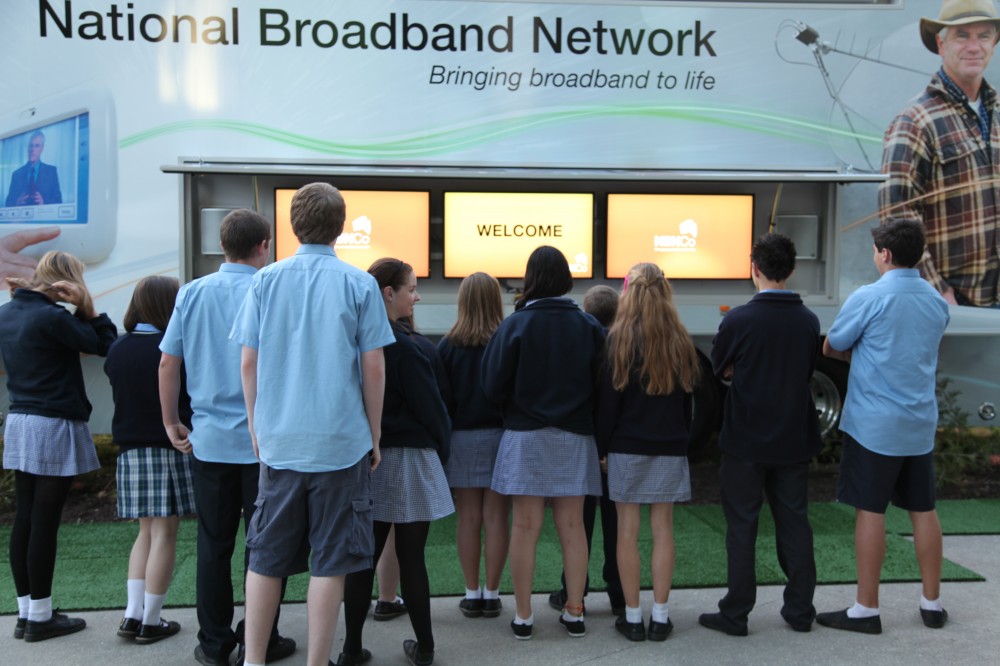
From 'NBN Co Truck national tour' image gallery
For anyone who believes that marketing adds little value to business, it’s worth reading Nick Ross’s NBN article/rant on the ABC Technology and Games site (‘The great NBN fail‘). Essentially, Nick vents his frustration with the poor effort that has been made in marketing and communicating the benefits of Australia’s national broadband network rollout: “In a nutshell, Labor and NBN Co’s failure to explain the NBN’s benefits is undermining the entire project.”
I made a similar point in a blog post last year – ‘Putting a Value on the NBN‘ – where I concluded “the real need at the moment is for government bodies, industry and community groups, with a vested interest in seeing the NBN rolled out, to quantify where possible the benefits the NBN will bring to their area of operation.”
Nick writes: “The lack of information in the public or media domains means there’s virtually no positive coverage of the NBN at all. It’s also resulted in the deployment being politicized and people choosing who they want to believe rather than basing their opinions on all the facts. The blame list is long and leaves few politicians, NBN employees and media people untouched but the underlying cause is that the NBN is currently the victim of what must be some of the worst marketing in the history of Australia.” [my emphasis]
The focus so far in NBN marketing has been on technology ‘speeds and feeds’, which areas are being connected and when, and how the NBN works. When you are trying to justify a $43 billion infrastructure spend, you’ve got to show people the big picture as well.
I read in one of the comments to the article (287 at last count!) that Todd Sampson’s Leo Burnett ad agency had won a contract to ‘sell’ the NBN. With the incredible impact of the Earth Hour concept, that at least sounds like a step in the right direction.
#OptusNRL and the Future of Sports Broadcasting
 Back in October last year, I wrote about watching a live video stream of a hockey game between Australia and New Zealand, and that I was “struck by the fact that this is the future of sports broadcasting”. A landmark decision last week – referenced on Twitter as #optusnrl – has brought this issue to mainstream attention.
Last week, the Federal Court of Australia found in favour of Optus in a copyright case brought by the Australian Football League (AFL), the National Rugby League (NRL) and Telstra (see further Blake Dawson’s case summary).
The case centred on the Optus TV Now service which allowed Optus customers to watch recordings of free-to-air TV with just a two minute delay. At stake were the exclusive rights bought by Telstra to stream live coverage of football matches to mobile devices.
While I’m not going to debate the legal aspects to the case, an insightful piece from Stilgherrian in today’s Sydney Morning Herald draws the link between the Optus TV Now case and the fact that technology is now at the point where a direct connection can exist between the sport and its audience:
“The National Broadband Network will enable sporting bodies to cut out the middlemen entirely, except where government anti-siphoning laws force some games to be shown free.”
I came to pretty much the same conclusion last year, with more of a focus on the implications for ‘fringe’ sports:
“…what better way to do that than by providing direct access to the Australian public … with the improvements in bandwidth that will come with the rollout of the NBN, watching a live broadcast of a sporting event – no matter how ‘fringe’ – will become commonplace.”
That said, I don’t think we’ve seen the end of legal action on #optusnrl.
(Pictured: “Kookaburras Hockey”, rosswebsdale, available under an Attribution-NonCommercial-ShareAlike 2.0 Generic (CC BY-NC-SA 2.0) licence.)
 explorecomms.com.au
